

For the last decade, high-growth companies lived by one rule: “move fast and break things.”
That era is over. In 2026, the new imperative is simple. Move fast and automate everything.
The business landscape is splitting. On one side, organizations are drowning in “manual drag.” This is the invisible friction of copying data between spreadsheets, chasing approvals via email, and manually qualifying leads.
On the other side are “self-driving” enterprises. These companies have decoupled growth from headcount. Their secret is leveraging Business Process Automation (BPA).
But what is BPA in the modern context? It is no longer just a simple email autoresponder. Today, BPA has evolved into Intelligent Process Automation (IPA). AI agents, low-code infrastructure, and complex logic now combine to execute entire job functions without human intervention.
This guide deconstructs BPA. We will explain how it differs from Robotic Process Automation (RPA) and show you how to transform static operations into dynamic, automated ecosystems.
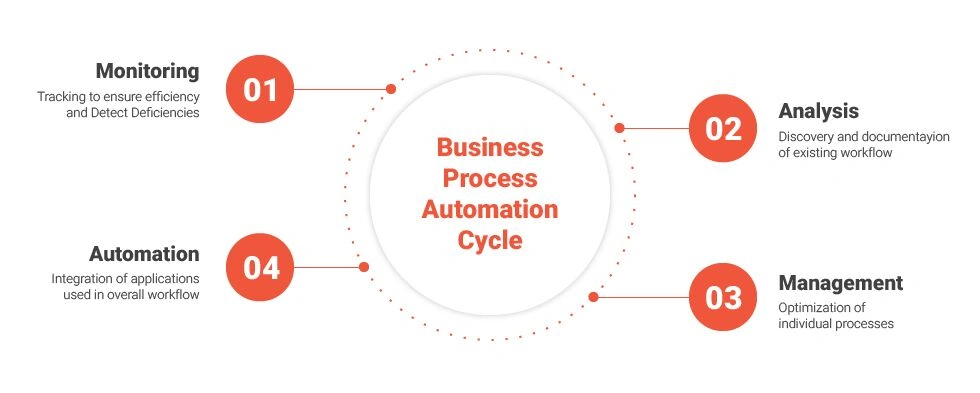
What is Business Process Automation (BPA)?
At its core, BPA uses technology to automate repeatable, multistep business transactions.
It goes beyond simple task automation. It does not just automate a single keystroke. Instead, BPA orchestrates complex end-to-end workflows that span multiple departments and software applications.
BPA focuses on the “process” rather than the “task.” It doesn’t ask, “How can I type this invoice faster?”
It asks, “Why are we typing invoices at all?” It then builds a system where the invoice is generated, sent, and reconciled automatically the moment service is delivered.
The Modern Definition: From Static to Agentic
Historically, BPA was rigid. It followed strict “If-Then” rules. If a form is submitted, send an email.
This approach was useful, but it broke down when complexity arose.
In 2026, BPA has merged with Artificial Intelligence to create Agentic Workflows. These systems are capable of reasoning. They do not just follow rules.
A modern BPA system can analyze the sentiment of a client email. It can decide whether to escalate it to a human or draft a reply. It updates the CRM simultaneously.
This is the domain where Thinkpeak.ai operates. By combining advanced AI agents with robust internal tooling, businesses can build their own proprietary software stack. This moves you beyond simple automation into full-stack operational independence.
BPA vs. RPA vs. IPA: Clearing the Confusion
To implement automation effectively, you must understand the technology hierarchy. These terms are often used interchangeably, but they represent very different capabilities.
| Acronym | Full Name | The Analogy | What It Does |
|---|---|---|---|
| RPA | Robotic Process Automation | The “Digital Intern” | Mimics human clicks and keystrokes. It is a “band-aid” over legacy systems that lack APIs. |
| BPA | Business Process Automation | The “Digital Manager” | Holistically re-engineers the workflow via API integrations and backend logic. It fixes the root cause. |
| IPA | Intelligent Process Automation | The “Digital Employee” | Combines BPA with AI (Machine Learning, NLP). It can handle unstructured data and make decisions. |
Why the Shift Matters
Many businesses make a critical mistake. They invest heavily in RPA to patch outdated systems.
RPA has its place, but it is fragile. If a button moves on a website, the bot breaks. Modern BPA, especially when paired with AI (IPA), is resilient.
It connects systems at the data layer. This ensures your operations continue seamlessly, regardless of surface-level interface changes.
The State of BPA in 2026: Key Statistics & Trends
The urgency to adopt BPA is driven by hard data. Recent market analysis highlights a rapid shift:
- Market Growth: The global BPA market is projected to grow from roughly $15 billion in 2024 to over $32 billion by 2030. This is driven by the need for operational resilience.
- The ROI Gap: 73% of organizations have adopted some automation, yet only 31% report significant ROI. Why? Most buy generic tools instead of engineering bespoke workflows.
- Hyperautomation: Markets for hyperautomation (combining RPA, BPA, and AI) are exploding. Gartner predicted this sector would reach $65.7 billion by 2025.
- Cost Reduction: Properly implemented BPA can reduce operational costs by up to 30% within three years. Simultaneously, it increases process speed by 50%.
The data is clear. Mere adoption is not enough. Success lies in strategic implementation.
This is why Thinkpeak.ai offers a dual approach: an Automation Marketplace for immediate templates, and Bespoke Engineering for complex infrastructure.
Strategic Use Cases: How BPA Transforms Industries
Abstract definitions are useful, but examples drive action. Here is how advanced BPA is deployed across critical business functions today.
1. Marketing: The Omni-Channel Content Engine
The Old Way: A marketing manager records a podcast. They manually transcribe it, write a blog post, and draft three LinkedIn posts. They cut five video clips and schedule them one by one. This takes 15 hours.
The BPA Way: The video file is dropped into a watched folder. An Omni-Channel Content Engine triggers immediately:
- Transcription: AI transcribes the audio.
- Repurposing: An LLM agent extracts key insights. It drafts a blog post, a Twitter thread, and a LinkedIn carousel.
- Asset Creation: Another agent generates thumbnails and subtitles for short-form video clips.
- Scheduling: The content is queued into the CMS and social tools for approval.
2. Sales: The Automated “Hunter”
The Old Way: Sales Development Representatives (SDRs) spend 60% of their day researching prospects. They copy data into Salesforce and write generic “Just checking in” emails.
The BPA Way: An autonomous agent monitors intent signals, such as a prospect hiring for a specific role. It scrapes recent news and generates a hyper-personalized icebreaker.
It drafts the email and qualifies inbound leads instantly via WhatsApp. It books meetings only when the lead scores above a threshold.
3. Operations: Dynamic Resource Management
The Old Way: An operations manager manually checks inventory levels in a spreadsheet. They email the finance team to approve a purchase order.
The BPA Way: A low-code app tracks inventory in real-time. This is Dynamic Resource Management.
When stock hits a reorder point, the system generates a purchase order. It sends the PO to the CFO’s Slack for one-click approval. The supplier is emailed automatically, and the ERP is updated instantly.
The “Buy vs. Build” Dilemma in Automation
Leaders face a critical choice when implementing BPA. Do you buy a rigid SaaS tool, or do you build a custom solution?
Option A: The SaaS Trap
Buying a specialized SaaS tool for every problem leads to “subscription fatigue.” You end up with 20 different tools that do not talk to each other.
Your data gets trapped in silos. Your processes are forced to conform to the software’s limitations.
Option B: The Bespoke Stack (The Thinkpeak Approach)
The modern approach is to build a Proprietary Software Stack. By using low-code platforms and AI agents, you gain the power of custom software. This comes at a fraction of the cost and time of traditional engineering.
Thinkpeak.ai facilitates this through two channels:
- Instant Deployment (The Marketplace): For standard problems, do not reinvent the wheel. Use pre-architected workflows optimized for platforms like Make.com and n8n. These are “plug-and-play” solutions.
- Bespoke Engineering (Services): For unique business logic, Thinkpeak builds the infrastructure. Whether it’s a Custom Low-Code App or a complex backend, we act as the glue between your CRM, ERP, and communication tools.
How to Implement BPA: A 4-Step Framework
Implementing BPA is about change management, not just installing software. Use this proven framework to ensure success.
Step 1: The Process Audit
Before you automate, you must audit. Perform a Process Audit to identify tasks that are:
- High Volume: Done frequently (daily/weekly).
- Rule-Based: Follow a standard logic, even if complex.
- Prone to Error: Where manual entry leads to mistakes.
Warning: Do not automate a broken process. Automating chaos just creates faster chaos.
Step 2: Map and Optimize
Map the workflow visually. Identify bottlenecks and approval delays. Optimize the process before applying technology.
This is where Thinkpeak’s Bespoke Internal Tools service shines. We design streamlined admin panels that sit on top of your data to visualize the workflow.
Step 3: Select the Right Stack
Choose your tools carefully. In 2026, the best stacks usually involve:
- Orchestrators: Make.com, n8n.
- Interfaces: Softr, Glide, Retool.
- Intelligence: OpenAI API, Anthropic Claude.
- Database: Airtable, PostgreSQL, Google Sheets.
For high-volume data, utilities like Thinkpeak’s Google Sheets Bulk Uploader are essential. They clean and format thousands of data rows across systems in seconds.
Step 4: Deploy and Iterate
Start small. Deploy a single agent, such as a Google Ads Keyword Watchdog, to monitor search terms and save budget.
Once the team trusts the automation, expand to complex workflows like full-stack HR onboarding.
The Future: Agentic AI and “Digital Employees”
The future of BPA is not just about scripts. It is about Autonomous Agents. We are moving toward a workforce where “Digital Employees” work alongside humans.
These agents are capable of:
- Decision Making: Evaluating data and choosing the best course of action.
- Self-Correction: Identifying when a task fails and retrying with a different method.
- 24/7 Execution: Working continuously without fatigue.
Thinkpeak.ai is at the forefront of this shift. We offer Custom AI Agent Development. These are not just chatbots; they are functional entities. They can execute tasks ranging from SEO research to Meta Ad analysis autonomously.
Conclusion: The Automation Imperative
Business Process Automation is no longer a luxury for enterprise giants. It is a survival requirement for any business intending to scale in 2026.
The gap between companies that automate and those that rely on manual labor is widening every day.
The choice is simple. You can continue to pay humans to act like robots. Or, you can build a fleet of robots to empower your humans.
Ready to transform your operations?
You may need immediate workflows from the Automation Marketplace. Or perhaps you need a fully Bespoke Internal Tool built from the ground up.
Thinkpeak.ai is your partner in building a self-driving business.
Frequently Asked Questions (FAQ)
What is the difference between BPA and BPM?
Business Process Management (BPM) is the broader methodology of managing and improving processes. BPA is the technological execution of that methodology. Think of BPM as the architectural blueprint. BPA is the construction machinery that builds it.
Is BPA expensive to implement?
Traditionally, yes. However, with the rise of low-code platforms and agencies like Thinkpeak.ai, costs have plummeted. You can now deploy enterprise-grade automation for a fraction of the cost of hiring a new employee.
Can BPA replace human employees?
BPA replaces tasks, not necessarily jobs. It removes repetitive, low-value work like data entry and scheduling. This frees employees to focus on strategy and creativity. We call this creating “Digital Employees” to support your human team.
Which departments benefit most from BPA?
While almost any department benefits, the highest ROI is usually found in:
- Sales: Lead qualification and outreach.
- Marketing: Content creation and ad optimization.
- Finance: Invoice processing and expense approvals.
- HR: Employee onboarding and document collection.